Blur, Grain, and No Retakes: How Film Cameras Became Gen Z's Coolest Summer Statement
Somewhere between the fourth notification of the morning and the fifteenth photo retake that still doesn't look right, something snapped. Not a shutter — a nerve. And Gen Z, collectively, decided they were over it.
Enter the film camera. Grainy, unpredictable, gloriously unforgiving. The little plastic disposable you used to find at your cousin's wedding in 2003 is now the most coveted accessory at every rooftop party, road trip, and golden-hour hang from Brooklyn to Malibu. And trust — this isn't just a TikTok phase. It's a full-on cultural rerouting.
The Notification Fatigue Is Real
Let's be honest about what we're all running from. The average smartphone user gets somewhere north of 80 push notifications a day. Every photo you take is instantly analyzable — brightness, composition, filter, engagement potential. The pressure to document perfectly has quietly turned summer memories into a second job nobody applied for.
Film cameras short-circuit all of that. You get 24 or 27 exposures, no preview screen, and zero ability to delete the blurry one where your friend was mid-blink. That constraint? Turns out it's the whole point. When you can't endlessly optimize, you stop trying to. You just shoot — and then you wait.
That waiting period, the days or weeks between snapping and developing, is something Gen Z is actively romanticizing. It's anticipation in an era of instant everything. It's the analog equivalent of not checking your texts back.
Film as a Style Statement
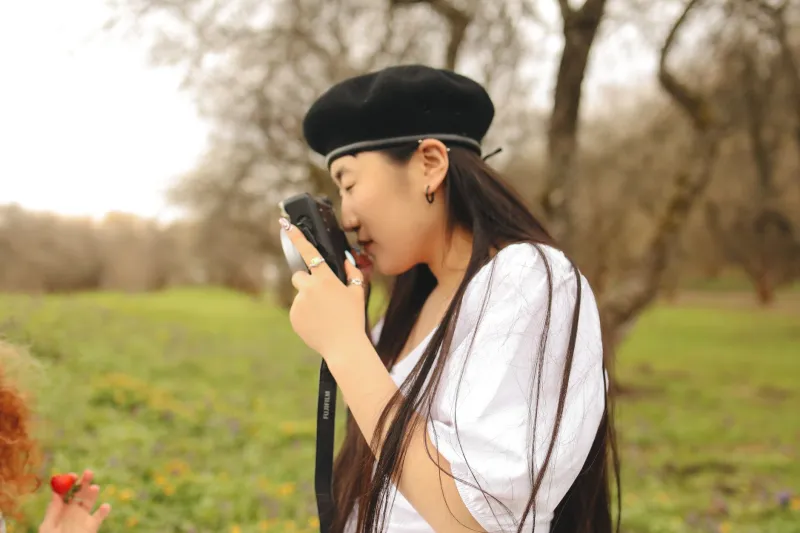
Here's where it gets fashion-forward: the camera itself has become an accessory. A chunky yellow Kodak FunSaver hanging off a wrist strap. A vintage Canon Sure Shot tucked into a canvas tote. A Fujifilm disposable peeking out of a denim jacket pocket. These aren't just tools — they're style signals.
Thrift stores and eBay listings for working 35mm point-and-shoots have seen price surges that would make a sneaker reseller blush. Brands like Kodak and Fujifilm are leaning in hard, dropping limited-edition colorways and collaborating with photographers who shoot exclusively on film. Meanwhile, indie camera shops in cities like Austin, Chicago, and Los Angeles are reporting their busiest years in over a decade.
The look of film — that warm grain, the slight overexposure, the occasional light leak — has also infiltrated digital aesthetics so thoroughly that entire preset packs exist to mimic it. Which is kind of hilarious, right? We're digitally recreating the imperfections of a technology we abandoned, while simultaneously running back to the original. Both things are true and somehow neither is wrong.
The Economics of Imperfection
Okay, let's talk money, because film photography is not cheap and Gen Z is nothing if not financially aware. A single roll of 35mm film runs anywhere from $10 to $20 depending on the brand. Development at a local lab? Add another $15 to $25. Scanning for digital copies? That's potentially another $10 on top. You're looking at roughly $40 to $60 for 36 photos — photos you haven't even seen yet.
For a generation navigating student loans, sky-high rent, and a gig economy that never fully clocks out, that's a deliberate spend. And that deliberateness is exactly the point. When a photo costs real money to produce, you're more thoughtful about what you shoot. You frame it. You feel it. You commit.
The perceived value of those physical prints — something you can hold, tape to a wall, tuck into a journal — is something a camera roll of 4,000 smartphone photos simply cannot replicate. There's a reason film photo walls have replaced vision boards as the go-to dorm room and apartment décor move. Scarcity creates meaning.
Summer Documentation, Reimagined
The way Gen Z is using film cameras is fundamentally changing how summer gets remembered. Instead of curated Instagram grids built around a color palette, the vibe is now tactile. Physical photo albums — yes, actual albums — are making a comeback. Strings of developed prints clipped across bedroom walls. Envelopes of photos mailed to friends across the country just because.
This shift is also showing up in how summer events get documented socially. At concerts and parties where everyone used to have their phone up for the whole set, you're increasingly seeing one person with a disposable camera taking maybe three shots the entire night. Those three shots carry more narrative weight than 200 phone videos that nobody will ever rewatch.
Photographers like Petra Collins and younger creators building audiences on platforms like VSCO and even Pinterest are championing this lo-fi visual language as the new premium. Grainy is the new glossy. Candid is the new editorial.
The Authenticity Economy
At the core of the film revival is something bigger than cameras or aesthetics — it's a hunger for things that feel real. Gen Z has grown up in the most documented generation in human history and somehow ended up with the least authentic visual record of their lives. Every photo has been filtered, edited, and optimized for an audience. Film breaks that loop.
You cannot run a film photo through Facetune. You cannot swap out the background in Lightroom without it looking like exactly what it is. What the camera captures is what happened. Red eyes, harsh shadows, a stranger walking into the frame — all of it stays. And weirdly, that imperfection is what makes it feel like a real memory rather than a content deliverable.
That authenticity is also what's making film photography a status symbol in a way that's almost counterintuitive. In a world where everyone has access to a 48-megapixel smartphone camera, choosing to shoot on a $12 disposable is a flex precisely because it signals you're not trying to impress anyone. You're just living.
The Bottom Line
The revenge of the analog isn't about rejecting technology wholesale — Gen Z is still very much online, very much posting, very much building digital lives. It's about carving out a pocket of experience that belongs entirely to the moment, not to the algorithm.
Film cameras give you that pocket. They make you slow down, look harder, and commit to the shot before you take it. They turn summer into something you experience instead of something you produce.
And honestly? In a world that keeps asking you to optimize everything, shooting 27 frames and letting the rest go might be the most radical act of self-care going this summer. Stay golden, stay grainy.